![FDClockTower-Cutout[3325].png](https://static.wixstatic.com/media/0d4607_6da264acdddc4b12a964a083b60a72b5~mv2.png/v1/fill/w_131,h_206,al_c,q_85,usm_0.66_1.00_0.01,enc_avif,quality_auto/FDClockTower-Cutout%5B3325%5D.png)
Education
HISTORY
Fort Dodge has a long history of education. The first school in Fort Dodge was taught by C. C. Carpenter, (a young surveyor who later became the Governor of Iowa) in the winter of 1854-55. The first school in Fort Dodge was housed in the bake house of garrison soldiers, prior to 1956.
There were twenty students. With the need for more space, the second school was located further west of the original school in the only church and temperance hall in Fort Dodge. Dexter Weller was the teacher and there were forty students. Legend has it that the school was so cold during the winter that the ink froze while the students were using it and the drinking water froze in the pails before the students could drink it.
The third school, started in 1856, was the first public school. Henry Gunn was the first teacher. This school was located at the corner of 2nd Avenue South and 7th Street. It was a two-story brick building known as “Old Brick” and served as a public school for twelve years. “Old Brick” was the only public building in town and was used for holding court, political meetings, church, festivals and other public affairs. After the Spirit Lake Massacre, many local settlers living north and west of Fort Dodge took refuge in “Old Brick”. It was also where the two companies for the Spirit Lake expedition were organized to make the trek to bury the dead and confront the Indians after the Massacre.
Fort Dodge had its first divided school in 1860, with an upper and a lower grade. The school continued for three years. Following the war, the number of students grew in Fort Dodge grew significant by 1868. The school board built a large frame school house at Second Avenue South and Eighth Street to house the extra students. It had three rooms and was used until 1869.
In 1869, Fort Dodge had grown in population, so bonds were issued and a new twelve-room school was started at the corner of 2nd Avenue North and 10th Street. However, five months later on January 20, 1870, the school building burned to the ground. The school board used the insurance they collected and began a new building on the same location, Second Avenue North and Tenth Street. This new building was ready for use in the fall of 1872. Until it was completed, classes were held in various places: churches, empty store rooms, etc. The new building was named for D. K. Lincoln, president of the school board and an outstanding citizen. The building was then on the edge of town, and people complained of having to send their children “way out on the prairie” to school. It was often referred to as the “School on the Prairie.” The Lincoln School housed all grades, with the high school on the third floor.
In 1869, the Lincoln School was the only public school building in Fort Dodge. In 1872 the teaching staff consisted of ten women and one man. Early records do not speak of anyone as principal but refer simply to superintendent, or professor, as he was called. The high school became known for its progressive ideas. New supplies needed in the building were paid for by socials, programs, bazaars, suppers, etc., which students and teachers worked out as money-making projects. Lincoln School had about 350 pupils in attendance. The first high school graduating class was in 1875 – two young women and one young man made up the graduating class. In 1877 there was no graduating class. In 1878 seven students graduated and in 1879 only four. This was at a time when most Iowa towns only carried education through 8th grade. In 1875, there were very few high schools in Iowa, as many Iowans did not see high school as an educational necessity.
Even by 1890, high school level education was still fairly rare in Iowa as there were only 88 school districts in the state that offered four years of high school. Government and educational leaders at the state harbored concerns about the education system in Iowa. They argued that the organization of high schools reflected the growing public need for higher education and the high school should be the crowning glory of Iowa’s public education system. At that time, the existing high school curriculum was influenced by college admission requirements. This was a problem, because most students at that time required education and training for bookkeeping, business, journalism, dressmaking, agriculture and other “trade” type jobs, rather than a university education.
The 1890s were a time of soul-searching for Iowa educators. Out of the ferment of debate and discussion emerged a consensus around the belief that public schools must identify with the democratic, scientific, and technological forces of modern society and that they must reach out to all segments of the population. In so doing, the schools must work with other social agencies, such as the home, the church, and business, to educate the whole child: "the head, the heart, and the hand," to use a recurring phrase of the time.
Outside of the city in the county, one-room school houses were very common. In fact, in the state of Iowa there were as many as 12,000 to 14,000 one-room school houses at one time. Some national educational reports indicated that Iowa had more one-room school houses than any other state in the nation. Generally, a school was constructed near the center of the sub-district in every township so that no child had to travel more than two miles to school. In the late 1800s and early 1900s, the kids all walked to school.
By 1897 the population of Fort Dodge had grown to 14,000. A new high school building was necessary. It was built on First Avenue North and Tenth Street. It was a three story building of yellow brick with many large windows and three outstanding entrances. Every foot of space in it was used. An unusually high basement had been built so that it could house the superintendent’s office, three recitation rooms, a bicycle room, a gymnasium, coal, boiler, and heating coil rooms.
The period between 1890 to 1920 was a time of educational growth and reform in Iowa which impacted education in Fort Dodge. The education movement began transitioning from the small, one-room country school approach, to a more regulated and large school model for providing public education. Consolidations started occurring shortly after the turn of the 20th century, but they started reaching a fever pitch when the automobile – and reliable roads – became a mainstay. Turn-of-the-last-century education reform – compulsory attendance through age 14 and required curriculum and textbooks – put the one-room schools on track to eventual demise.
Between 1890 to 1922, the population of Fort Dodge grew significantly and the need for more schools became a priority. During this time period, eleven schools were organized and constructed in Fort Dodge.
1890: Arey School was built
1891: Wahkonsa School was built
1893: The first Riverside School was built
1897: New High School on 1st Ave. North
1910: Butler School built
1912: Second Wahkonsa School built to replace the first one that burnt
1912: Duncombe School built
1914: Pleasant Valley School built
1917: Carpenter School built
1917: Hawley School built
1922: Fort Dodge High School
In 1899, there were thirty-eight teachers employed, not including the superintendent, and the buildings then in use were the Pottery, First Ward, West Fort Dodge, Arey, Wahkonsa, Lincoln, and the new high school building.
Most of the social activities held by high school groups in the early days were held in the homes. Football was introduced into the school in 1894. Interclass baseball was also played. In 1897 basketball for both boys and girls appeared. Those who played football in those days furnished their own equipment and did the coaching themselves.
The music department of the high school did not get underway until 1909. Then the first orchestra had six members. Athletics continued to grow in importance and around 1910 a coach was hired. An area for an athletic field was bought just east of Duncombe School.
In June of 1907. the high school building was damaged by fire. Because it was not totally destroyed, it was restored and ready for school in the fall. Due to an increased enrollment, several rooms were enlarged.
By 1918, the high school building on First Avenue North rapidly became outgrown. In 1919, petitions were started to ask the Board of Education to call an election to vote to issue bonds so a new lot might be bought and a new school be built and equipped. The vote for a new school carried easily.
Because Fort Dodge had spread out on both sides of the river and the distances from outlying districts were great, the question of a location for a new school was important. A consultant from Iowa City surveyed the city, found the center of population, and suggested a location. The Board then chose the site located at 1015 5th Ave North. The building was ready in September, 1922. It was built of dark red brick and is three stories high. Compared to the previous high school, it looked large and massive. (This building eventually became North Junior High after the new high school was built in 1958).
In 1921 the Fort Dodge School system added advanced courses beyond the regular four year high school program as the first step toward the establishment of a junior college, a new educational concept of the times. The college classes occupied the third floor of the new high school. The junior college was an extension of the Fort Dodge School System. The first teachers were high school teachers given additional assignments, a practice necessary because state funding did not extend beyond high school. The practice continued until the 1950s. Fort Dodge was the third school in the state to establish such a program.
During the following three decades, education continued to transform but no new school buildings were built until World War II ended. In the late 1940s and through the 1950’s, the rural population began to decline and with educational regulations increasing and stricter teacher qualification standards, maintaining the country schools was no longer feasible. As county roads continued to develop and vehicles improved, bus transportation also became a better option. When country school students began attending school “in town” in the late 50’s and early 60’s, it put a squeeze on the available space. The “Baby Boom” generation of students hit Fort Dodge and the community had to respond by building five new schools including a new high school in 1958. By the early 1970’s, public school enrollment hit all-time highs. The schools listed here were built during this period:
Fort Dodge Senior High and Junior College (1958)
Highland Park School (1952)
Hillcrest School (1956)
Cooper School (1956)
New High School (1958)
Feelhaver School (1968)
At the start of the 21st century, the schools built in the 1950’s had aged and three new schools have been built; the new Butler Elementary School in 1999; the new Middle School in 2013 and the new Duncombe Elementary School in 2017.
All four Fort Dodge elementary schools were named after iconic Fort Dodge leaders;
Butler Elementary: Name after J.B. Butler, an education leader and school board member for 27 years.
Feelhaver Elementary: Named after Charles Feelhaver, a highly respected school superintendent for Fort Dodge for twenty years.
Duncombe Elementary: Named after the renowned Fort Dodge attorney, school board president and community leader, Charles Duncombe.
Cooper Elementary: Name after Fred Cooper, renowned coach and educational leader.
Today, public school enrollment is approximately 3,600 students. Fort Dodge Community Schools offer one early learning center, four elementary schools, one middle school and one high school. The Fort Dodge Community School System offers students a wide range of academic courses, vocation classes, athletic, arts and extracurricular activities.
Sources:
*Iowa Department of Education
*Iowa Biographies Project: History of Fort Dodge and Webster County, Iowa… by H. M. Pratt
1913 - Chicago: The Pioneer Publishing Company
*Fort Dodge in Pioneer Days …. 1944… by Lucy Taff
*Wikipedia

Arey School
The streets of Fort Dodge were not always named as they now are. In the earlier days of Fort Dodge Arey School would have been located between Walnut and Locust, Morrison and Main streets. Today these streets have become First and Second avenues, Sixteenth and Seventeenth streets. The school was located at intersection of 1st Avenue South and South 17th Street.
The first Arey School was built between 1889 and 1890. It was named for Melvin F. Arey who was superintendent of schools at the time. This first building had only four rooms. These four rooms were torn down in 1900 so that a larger building (shown here) could be built that was finished in 1901.
At first the playground was very small so in 1915 the board of education bought the north half of the block. There was a house on the lot so they moved it west of the main building and made a kindergarten room and a room for domestic science classes in it. Later the domestic science classes were sent to another building. In the same year they also made a basement room of the main building into a classroom where the preliminary class met. The preliminary class was really the kindergarten A class, but in the earlier years the children learned how to read and had a separate teacher.
Arey Grade School Alumni – Around the late 50’s
The large lot which had been purchased for a playground was often flooded and made into an ice skating rink in winter. During the summer the playground was used for recreation purposes.
When the preliminary group became kindergarten “A” and was taught by the regular
kindergarten teacher, the basement room became an assembly and music room. An upstairs room, not needed as a classroom, was converted into an attractive all school library in 1943.
With the growth of population and an outdated building, a new Arey Elementary School was built in the same location at the intersection of 1st Avenue South and South 17th Street. The new Arey School was built in 1965. The Arey Elementary School was closed in the 1980’s and was converted into the public school administration office building.
Sources *Fort Dodge in Pioneer Days …. 1944… by Lucy Taff
*Fort Dodge – Postcard History …. Megan Bygness and Pamela Bygness

History of the Public Schools
1845
Fort Dodge has a long history of education. Parochial schools played a significant role in Fort Dodge education beginning in the 1860’s.
Arey Elementary School
1889
The first Arey School was built between 1889 and 1890. It was named for Melvin F. Arey who was superintendent of schools at the time. This first building had only four rooms.
Butler School began in a rented house on south Twenty-second street in 1906. The district was then known as the Oleson Park district. The school board rented a one-room house, and three grades were taught in it. The next year the board rented another one-room house on Twentieth street and three grades were also taught there. Both of these early schools were under the supervision of Arey School.
In 1910 a new building was built in the Oleson Park district. It was named Butler School for Mr. J. B. Butler who was an active, helpful member of the school board at the time. Mr. and Mrs. Butler were always interested in the school and presented it with a picture that was hung in the hall.
At the time the school opened in 1910 only four rooms were needed. The board had built the building larger because they expected the southeastern part of the city would grow. That is exactly what happened, and soon all the rooms were needed.
In fact the district grew so rapidly that in 1928 a six-room addition to the building was completed. This made a sixteen-room modern school building.
Many changes have happened in Butler District since it began, back in 1906. The first school had a Round Oak heating stove while the present one has a modern heating and ventilating system. The first Butler School had a tin dipper and pail for drinking purposes. At first the little one-room buildings were out in the open spaces, often win swept and snow blocked.
One of the outstanding features of Butler School is its playground which is a recreation center throughout the year. The playground covers four acres and is well equipped for physical education and forms of recreation.
The building has an attractive all school library where children meet for regular library periods. A music room for both instrumental and vocal activities is enjoyed by the students and teachers. It often becomes an assembly room for interesting programs.
The setting of Butler School makes Oleson Park available for nature study, hikes, picnics, etc. The Great Western Bridge which is easily visible from the building has been and always will be a source of interest and fascination to the children.
With an increasing enrollment and a building that was close to 90 years old, the Fort Dodge Community School Board began planning for a new building for Butler Elementary in 1997.
The new Butler Elementary School was built in 1999 in the same location as the original Butler School. Butler Elementary serves approximately 500 students in kindergarten through fourth grade. Its goal is to provide a safe, fun and stimulating environment where all kids can learn and excel.
Sources:
*Fort Dodge in Pioneer Days …. 1944… by Lucy Taff *Fort Dodge Community Schools website
Butler School
1906
Butler School began in a rented house on south Twenty-second street in 1906. The school board rented a one-room house, and three grades were taught in it.

Carpenter School has the honor of being named for ex-governor Cyrus Clay Carpenter, the teacher of the first public school in Fort Dodge. In 1925, a bronze plaque of the Gettysburg Address was presented to the school by the Sons of Union Veterans and its auxiliary in cooperation with Carpenter’s Parent Teachers’ Association. The governor of Iowa in 1925, as well as the mayor of Fort Dodge, were present when the presentation was made. A picture of Governor Carpenter was presented to the school by the Carpenter family.
The original school was completed in 1917 at was located at 1301 S.24th Street. The enrollment quickly doubled.
Carpenter School was closed by the fall of 1976. The building at the location now serves as the home of the Early Childhood Center that provides childcare and afterschool programs for children from infants to age 12.
Carpenter Elementary School
1917
Carpenter School has the honor of being named for ex-governor Cyrus Clay Carpenter, the teacher of the first public school in Fort Dodge.

Giving the Fort Dodge area an option for Christian-based, protestant education, Community Christian School has a history of providing high quality educational services in the Fort Dodge area since 1978. Many families representing over 25 churches have selected Community Christian School as their school of choice, based on its commitment to a philosophy of Christian education and academic excellence, small class size, commitment to building Christian character, ministry-minded staff that truly care about each individual student, the safe environment provided, and opportunity for parental involvement.
Community Christian School (CCS) was founded on January 18, 1978, through a vote taken by the members of the First Evangelical Free Church (FEFC) of Fort Dodge (now Crossway Church). Classes began in the fall of 1978. A high school was added in 1980 and operated until 1991. The intent was to “parent and guide a Christian school” that would be nondenominational in its focus and teachings yet would stress those central truths of the Bible that unite Christians. Classes met for the first time in the fall of 1978.
The school remained housed in the basement of FEFC until the spring of 2013 when the school relocated to 2406 9 and 1/2 Avenue South, Fort Dodge, (formerly the Holy Rosary Church and School). At that time, the school also became an independent, non-denominational school no longer governed by the FEFC. In January of 2018, the school added a daycare center to CCS serving infants to school age children.
CCS provides education for students pre-K through 8th grade. CCS is currently accredited by the State of Iowa and is pursuing accreditation with Christian Schools International (CSI).
Community Christian School’s Mission is: Serving God by providing families an academically-excellent, Biblically-integrated education, which encourages spiritual development and social responsibility in an environment where students can develop their God-given gifts and talents.
Source:
*http://www.ccsfd.org
Community Christian School
1978
Giving the Fort Dodge area an option for Christian-based, protestant education, Community Christian School has a history of providing high quality educational services in the Fort Dodge area since 1978.

Construction of Duncombe School was begun in 1912 when the school board saw there was a growing need for a school in the northeast section of the city. When the land for Duncombe School was purchased, it was a truck garden planted with corn. There were only two or three houses to the north of the school and none to the east. So the school was practically out in the country.
When the plan for the building was made, it called for eight classrooms, a community room, office, and a rest room. Many people said this was too large a building for the needs of the time. But the school board realized that this section of the city would grow. This proved to be true because the very first year the school was used, all eight rooms were filled, and a kindergarten was arranged for in the basement. They were still crowded for space. So the office became a supply room and the rest room an office. Later the community room became two classrooms making the building an eleven classroom structure operating on three floors.
In 1925 an annex of two rooms, moved over from Lincoln School, was added, making a total of thirteen classrooms in use. The upper hall was also used for classes.
One of the reasons for the great need of classrooms was that the seventh and eighth grades were enrolled at Duncombe until the junior high was established in 1931. When the seventh and eighth graders went over to the Junior High there was more room available and the annex became space used as an assembly room for students and community activities. The basement of the annex was used as a practice room for high school wrestlers.
The building was named after Charles F. Duncombe who was president of the board of education at the time the school was constructed and was a distinguished citizen.
One of the outstanding features of the school was the large playground which covered two square blocks. The large field to the east of the school was the athletic field for high school football, baseball, and track practice until Dodger Field was completed.
In 2015, bricks began to fall from the 100 year old building forcing the building to be closed for safety reasons. The Duncombe School students were temporarily relocated to the former Fair Oaks Middle School that was previously closed when the new Fort Dodge Middle School Building opened in 2013. A bond referendum was passed by the citizens of Fort Dodge in 2016 to build a new Duncombe Elementary School at the same location as the original Duncombe School.
In 2017, the new Duncombe Elementary School was opened, replacing the 105 year structure. Duncombe Elementary serves approximately 450 students in kindergarten through fourth grade.
Sources:
*Fort Dodge in Pioneer Days …. 1944… by Lucy Taff
Duncombe School
1912
When the land for Duncombe School was purchased, it was a truck garden planted with corn. There were only two or three houses to the north of the school and none to the east. So the school was practically out in the country.

By 1868 the ever increasing school population of Fort Dodge had outgrown three upgraded buildings. So in that year bonds were issued, and a new twelve-room school house was started. It was ready for the school year in September, 1869. The building was built at the corner of 2nd Avenue North and 10th Street. However, five months later on January 20, 1870, the school building burned to the ground. The school board used the insurance they collected and began a new building on the same location. This new building was ready for use in the fall of 1872. Until it was completed, classes were held in various places: churches, empty store rooms, etc. The new building was named for D. K. Lincoln, president of the school board and an outstanding citizen. The building was then on the edge of town, and people complained of having to send their children “way out on the prairie” to school. It was often referred to as the “School on the Prairie.” The Lincoln School housed all grades, with the high school located on the third floor.
In 1872 the teaching staff consisted of ten women and one man. Early records do not speak of anyone as principal but refer simply to superintendent, or professor, as he was called. The high school became known for its progressive ideas. New supplies needed in the building were paid for by socials, programs, bazaars, suppers, etc., which students and teachers worked out as money-making schemes.
The first class of three members graduated on July 1, 1875. The graduating program was an elaborate one of declamations, dialogues, and music. In 1877 there was no graduating class. In 1878 seven students graduated and in 1879 only four.
In December, 1882, the town was given a scare when the fire bell rang and the high school was said to be on fire. School had been dismissed, but several boys who were still in the building helped Professor Arey put out a fire before the hose company arrived. They carried water up five flights of stairs. It is said that Professor Arey froze the fingers of both hands.
Football was introduced into the school in 1894. Interclass baseball was also played. In 1897 basketball for both boys and girls appeared. Those who played football in those days furnished their own equipment and did the coaching themselves.
By 1897 the population of Fort Dodge had grown to 14,000. A new high school building was necessary. It was built on First Avenue North and Tenth Street. It was a three story building of yellow brick with many large windows and three outstanding entrances. Every foot of space in it was used. An unusually high basement had been built so that the superintendent’s office, three recitation rooms, a bicycle room, a gymnasium, coal, boiler, and heating coil rooms were all found there.
This building was damaged by fire in June, 1907. Because it was not totally destroyed, it was restored and ready for school in the fall. Due to an increased enrollment, several rooms were enlarged.
Most of the parties held by high school groups in the early days were held in the homes. Occasionally, lectures were held in the building. The music department of the high school did not get underway until 1909. Then the first orchestra had six members.
Athletics became more important about 1910 when a coach was obtained. A small area for a practice field was bought just east of Duncombe School.
By 1918, the high school building on First Avenue North rapidly became outgrown. In 1919, petitions were started to ask the Board of Education to call an election to vote to issue bonds so a new lot might be bought and a new school be built and equipped. The vote for a new school carried easily.
Because Fort Dodge had spread out on both sides of the river and the distances from outlying districts were great, the question of a location for a new school was important. A consultant from Iowa City surveyed the city, found the center of population, and suggested a location. The Board then chose the site located at 1015 5th Ave North. The building was ready in September, 1922. It is built of dark red brick and is three stories high. Compared to the previous high school, it looked large and massive.
In 1921 the Fort Dodge School system added advanced courses beyond the regular four year high school program as the first step toward the establishment of a junior college, a new educational concept of the times. The college classes occupied the third floor of the new high school. The junior college was an extension of the Fort Dodge School System. The first teachers were high school teachers given additional assignments, a practice necessary because state funding did not extend beyond high school. The practice continued until the 1950s. Fort Dodge was the third school in the state to establish such a program.
During the following three decades, education continued to transform but no new school buildings were built until World War II ended. In the 1950s, the number of youth enrolled in the Fort Dodge public schools continued to grow. Country schools were closing and as county roads continued to develop bus transportation also became a better option. When country school students began attending school “in town” in the late 50’s and early 60’s, it put a squeeze on the available space. The need for a new high school became evident.
In 1958, a new high school was built on several acres of land located in the north-central part of Fort Dodge between Martin Luther King Drive and North 25th Street. By the early 1970’s, public school enrollment hit all-time highs. Fort Dodge Senior High enrollment surpassed 1,500 students for grades 10, 11 and 12.
Fort Dodge High School
1869
By 1868 the ever increasing school population of Fort Dodge had outgrown three upgraded buildings. So in that year bonds were issued, and a new twelve-room school house was started. It was ready for the school year in September, 1869.

In 1921, the Fort Dodge School system added advanced courses beyond the regular four year high school program as the first step toward the establishment of a junior college, a new educational concept of the times. The college classes occupied the third floor of the new high school on Fifth Avenue North.
The junior college was an extension of the Fort Dodge School System. The first teachers were high school teachers given additional assignments, a practice necessary because state funding did not extend beyond high school. The practice continued until the 1950s. Fort Dodge was the third school in the state to establish such a program.
For four years only the freshman year was offered and it wasn’t until 1925 that the sophomore year was added. The first class, consisting of thirty-one students, graduated from the junior college in 1926. The curriculum was limited to the traditional liberal arts until the 1950s when vocational courses and adult education were added and the school was renamed the Fort Dodge Community College which recognized the change.
In 1953, Fort Dodge Community College introduced a two year elementary teaching program and in 1960 the college became one of the first colleges in the country to offer a two year program for registered nurses which replaced the three year hospital associated program.
With the construction of the new high school in 1958, the college followed the high school to the new location. In 1960 the college was recognized as a separate entity from the high school with its own administrative structure. In 1965 the voters of Fort Dodge passed a bond issue for constructing buildings solely for the college and the Fort Dodge Betterment Foundation gave 100 acres just to west of Friendship Haven for a new college campus. The same year the state legislature passed landmark legislation creating the state wide community college system and Fort Dodge Community College became Iowa Central Community College with a nine county district.
Iowa Central was organized in 1966 after the State of Iowa issued a mandate that required the state to offer a vast array of educational opportunities to the residents of its nine-county area. Iowa Central was built on the foundation of three area junior colleges which had been operating in the region since the 1920’s by the local public school systems. Fort Dodge Junior College (organized in 1921), Webster City Junior College (organized in 1926) and Eagle Grove Junior College (organized in 1928) joined forces to become Iowa Central as a result of the Area School Act, passed by Iowa’s 61st General Assembly. This legislation authorized two or more county school systems to merge to form an area community college.
Nine counties comprise the Iowa Central region: Buena Vista, Calhoun, Greene, Hamilton, Humboldt, Pocahontas, Sac, Webster and Wright. The resulting Merged Area V has approximately 28,000 students in 31 public school districts. In 1971, a fourth center was added with the completion of a new building in Storm Lake.
Dr. Edwin Barbour became the first president of Iowa Central Community College, who at that time had been Eagle Grove’s superintendent of schools for more than a decade. Barbour served as president from 1966 through 1983. Dr. Barbour recalled the beginning this way: “When I became superintendent in the summer of 1966, only the foundations of the science and library buildings on the north end of our complex had been poured. Those buildings had been authorized by voters of the Fort Dodge Community School District which was then operating the two-year college. There was a soybean field where our administration and voc-tech buildings and parking lots now are, a vacant lot bordering U.S. 20 where the dormitories are…. We were scattered all over. The Dodge Building – a former bowling alley bordering U.S. 169, which later became Iowa Central Rehabilitation Industries – was one of our centers. We had seven temporary metal buildings as classrooms; we rented the old 4-H building on the grounds and the Shaffer Building near the Expo Pool.”
In 1975, Iowa Central joined with Buena Vista College in Storm Lake in a cooperative venture whereby students can earn a bachelor’s degree attending evening classes. The students’ first two years are completed at Iowa Central and the final two years at Buena Vista at the Fort Dodge center.
Today, Iowa Central has over 5,000 students of which 1,100 live on campus. Iowa Centrals offers 45 different degrees that transfer to a four year college; it has over 100 programs from which to choose; over 60 career and technical programs; Iowa Central holds 40 national championship titles and the student /teacher ratio is 19:1.
Iowa Central also partners with local high schools, whereby high school students can earn “dual credits” by taking “Early Bird” classes (i.e., college courses offered at Fort Dodge Senior High) at the high school and receive college credit upon completion. The high school provides the instructor. High school students can also take online courses and earn college credit while in high school.
Sources:
*Fort Dodge Historical Society - Fort Dodge History…. Roger Natte
*Messenger Newspaper… October 4, 2016
*www.iowacentral.edu
*Wikipedia
Fort Dodge Junior College/Iowa Central Community College
1921
In 1921 the Fort Dodge School system added advanced courses beyond the regular four year high school program as the first step toward the establishment of a junior college, a new educational concept of the times.

Fort Dodge Junior High
1922
The Junior High was organized in 1922 in the old Senior High Building when the new senior high building was completed in that year, and the four upper grades were transferred there.

Hawley School has one of the most beautiful settings in Fort Dodge. It is situated in the northwest part of
the city on a lovely ridge called Round Prairie. There are still many virgin trees around to add to the pleasant environment.
The building was erected in 1917. Before the school was built, the children of this district attended Pottery School and Wahkonsa School. Pottery School was a single room school on North First Street.
Hawley School was named in memory of Henry W. Hawley, who was at one time a prominent citizen of Fort Dodge. When he died, he left $10,000 to be given to worthy graduates of our high school as college scholarships.
Since Hawley School was built, Round Prairie has grown rapidly, and until it became necessary to use all the classrooms in the building and to make the gymnasium and part of the hall into additional classrooms.
Hawley School was closed around 1985.
Hawley School
1917
Hawley School has one of the most beautiful settings in Fort Dodge. It is situated in the northwest part of the city on a lovely ridge called Round Prairie. There are still many virgin trees around to add to the pleasant environment.
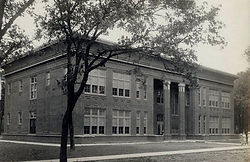
In 1868, the original Lincoln School was constructed. In January, 1871, this building burned, and the building which is still standing was built. For a time seventh and eighth grades were taken care of in this Lincoln Building. They were housed on the third floor of the Lincoln Building from 1869 until it was condemned as unsafe in 1913. The annex to the east of the main building was then used for classrooms for the 7th and 8th grades. As the enrollment in junior high grew, each district cared for its own seventh grade.
The Junior High was organized in 1922 in the old Senior High Building when the new senior high building was completed in that year and the four upper grades were transferred there. The seventh and eighth grade pupils were transferred from Lincoln School to the old high school building that was located on 1st Avenue North and 10th Street, and the first Fort Dodge Junior High came into existence. The fire marshal had condemned the third floor of the building so only the two lower floors were used.
In 1929 the land for new junior high building was bought and plans were made for the building that would accommodate the seventh and eighth grade students. The site for Junior High was chosen because the location was found to be the exact center of the school population at that time. In 1930, the city voted a bond issue for the erection of the building, and digging started August 1. The building was completed and accepted just one year later, August 1, 1931.
The Junior High building was located at 416 South 10th Street in Fort Dodge, Iowa. The school building was situated between 4th Avenue South on the north, 5th Avenue South on the south, South 7th Street on the west, and South 12th Street on the east. The site of the school includes grassy areas, trees, and landscaping on all sides of the building.
An athletic field was situated on a portion of level land within an otherwise steeply sloping hill just west of the school building. The hill slopes from the site of the school building to the athletic field.
In 1937, the school board decided to bring the ninth grade from senior high to the junior high building to make the Junior High system incorporate grades 7, 8 and 9. The senior high also needed more room for the three upper grades. A new addition was made to the Junior High building in 1937 to accommodate the added numbers. In 1965, another addition was added to the building to accommodate the growing student population.
Since 1937, the Fort Dodge Junior High consisted of three grades: seventh, eighth, and ninth until the Fort Dodge Community School board restructured the junior high system into a middle school model that incorporated the 5th and 6th grades in one building at the Junior High building (Fair Oaks Middle School), and grades 7 and 8 into the former senior high school building (Phillips Middle School). This transition occurred in 1992.
With two aging middle school buildings, the Fort Dodge Community school board began the planning for a new middle school in 2011. Besides offering a new, modern facility, the school board’s plan was to bring all four grades, 5-8, together in one building. The school board felt that one middle school building, in the long run, would be much more efficient and would save operating costs.
Early in the design process for this middle school, participatory workshops resulted in abandoning the idea of traditional classroom in favor of creating a new student-focused learning environment. Each learning environment (known as a learning community) was comprised of several learning centers and houses approximately 150 students. At the fifth and sixth grade levels, the learning communities each house six learning centers, including science studios. At the seventh and eighth grade levels, the learning communities each house five learning centers, including one science lab. In addition, each learning community offers spaces for specialized learning and teacher collaboration. At the center of each learning community is a common space that offers opportunities for individual, small group, and large group learning.
The new Fort Dodge Middle School building is located just four blocks east of the high school on 10th Avenue North and 32nd Street in east Fort Dodge. The new building was completed in August of 2013. The Fort Dodge Middle School serves approximately 1,100 students in 5th through 8th grade.
Lincoln School
1868
Lincoln School is the oldest of the school buildings in this city. In 1868, many students came into Fort Dodge. The school board saw a need for more room, so the first brick school building in Fort Dodge was completed on Lincoln School grounds.

The citizens of the district of Pleasant Valley were given the privilege of choosing a name for their new
school building. They chose the name, “Pleasant Valley”, because it describes the valley well, and because they hoped the school might be a pleasant place for everyone who worked there.
The Pleasant Valley district was known as the First Ward school in the earlier days. It has been impossible to locate the data of the first school house in the district. Early settlers think that the district is about 60 years old, but they do not know where the first building was located nor when it was built.
The first records found were in some school board notes of March 15, 1887. This seems to mean that the first school property in the district was bought in that year.
The building was known as the First Ward Building, Number 2. It was a one-room school house with an outside well and other inconveniences the children of the present day school never knew. The school had three grades and one teacher. By 1908 this school had grown to a three-room frame building with a teaching staff of three. The building was heated by stoves while water pails and public drinking cups provided water for the pupils.
In 1913 a Parent-Teacher Association was formed. That spring a petition for a new building was started and circulated. A special election was held, and money for a new school was voted. In 1914 the present school building was ready, having been built just across from the three-room building.
The brick building has seven classrooms and a gymnasium which is much used by the children as well as being a recreation center for adults in 1843 one end of the upper hall was converted into an all school library to which all grades come as part of their regular classwork.
Pleasant Valley School
1887
The citizens of the district of Pleasant Valley were given the privilege of choosing a name for their new school building. They chose the name, “Pleasant Valley”, because it describes the valley well, and because they hoped the school might be a pleasant place for everyone who worked there.
Presbyterian College/Fort Dodge Collegiate Institute
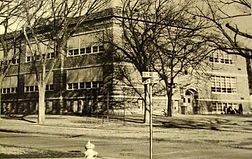
In October, 1883, the Calliope Academy was taken under the care of the Ft. Dodge Presbytery which then constituted the Northwest quarter of the state of Iowa. Two years later the school was moved to Ft. Dodge and given the name of the Ft. Dodge Collegiate Institute. It was located at the corner of First Avenue North and Fifth Street in a Victorian mansion referred to as the Haskell House, which twelve years later served as the first hospital in Fort Dodge. The Rev. F. L. Kenyon was chosen president and served in this capacity until the spring of 1889. He was succeeded by the Rev. L. Y. Hayes.
This school offered college preparatory courses, a traditional liberal arts program and a commercial program. It was very innovative for its time because it offered individualized instruction, night courses and simulated model banking and retailing experiences. It also had music, art, debate and speech. Its enrollment peaked at 95 students.
In 1891, the college closed due to financial problems. Presbyterian leaders decided that the school would not be successful located in Fort Dodge. Accordingly the Ft. Dodge and Sioux City Presbyteries, which had resulted from a division of the old Ft. Dodge Presbytery appointed a joint commission of twelve men to take into consideration a new location and the reorganization of the school.
After much careful and prayerful consideration of a number of propositions from different towns, the commission met in Storm Lake on the 8th of July, 1891, for final action. On the following day, the decision was made to locate the college in Storm Lake, Iowa, and reorganized the school. It was incorporated as Buena Vista College, (which became Buena Vista University in 1995). The college was first granted accreditation by the North Central Association of Colleges and Secondary Schools in 1952.
Source:
*The Presbyterian Church in Iowa - 1837-1900 – History – Prepared by Committee of Synod of Iowa
*www.bvu.edu
Presbyterian College
1813
This school offered college preparatory courses, a traditional liberal arts program and a commercial program. It was very innovative for its time because it offered individualized instruction, night courses and simulated model banking and retailing experiences. It also had music, art, debate and speech. Its enrollment peaked at 95 students.

Riverside School
1813
This school offered college preparatory courses, a traditional liberal arts program and a commercial program. It was very innovative for its time because it offered individualized instruction, night courses and simulated model banking and retailing experiences. It also had music, art, debate and speech. Its enrollment peaked at 95 students.

The Catholic schools played a significant role in Fort Dodge education beginning in the 1860’s. The Catholic community in Fort Dodge from the early pioneer days of the community has always valued the importance of providing students with Christ-centered education.
As early as 1862, there were two Catholic schools that were organized in the frontier Fort Dodge community. Our Lady of Lourdes Catholic School was established in 1862 by Father John Marsh and the original building was erected on what is known as "Seminary Square," a beautiful plat of ground just north of the Catholic church. The second Catholic schools was also established with the Corpus Christi Catholic Church. The Sisters of Charity of the B. V. M. came from Dubuque to conduct the classes. Unfortunately, the two schools were discontinued in 1866 due to financial challenges owing to the sparse population and the sisters returned to their mother house.
In 1874, the old school building was enlarged and under the direction of the Very Reverend T. M. Lenihan, a flourishing school was established. The Sisters of Mercy came from New York City and made this convent their mother house. Unfortunately, fire destroyed the buildings and for some years the parish was without a parochial school. A new Catholic school building was erected in 1901, at a cost of $25,000, and the Sacred Heart school was opened in 1902. The Sisters of Charity of the B. V. M., of Dubuque returned to Fort Dodge to teach the classes. By 1912, the Catholic school had ten teachers employed and an enrollment of 257
students.
Up until 1955, there were three Catholic high schools in Webster County; Corpus Christi and Sacred Heart High Schools in Fort Dodge, and St. Mathews in Clare. In 1947 Bishop Edmond Heelan announced plans to build a centralized Catholic high school in Fort Dodge to serve Webster County. Two major fund raising campaigns ensued, and enough money was raised to purchase a 22 acre tract of land (located at 501 North 22nd Street) and pay for the building of a new Catholic high school.
Mr. Robert Hermans was the general contractor on the Saint Edmond project. In a tragic development, Mr. Hermans passed away during the process. This unfortunate setback led to major issues in completing the building including significant cost increases. Mr. Hermans widow, Frances, came to the rescue. Fran Hermans sold a farm and used the funds to defray the cost overruns, thus bringing the building in at the original budgeted price. The Saint Edmond community owes a great deal of gratitude to the entire Hermans family for their gracious philanthropy.
The design of the new high school was not without conflict. When the school’s first Superintendent, Msgr. Gerald Kelly saw the design plan, he liked what he saw with one exception. Msgr. Kelly’s vision of the school included a full-fledged auditorium, not a stage in the gymnasium as was common in those days. At the time, Bishop Joseph Mueller argued against the auditorium, but Msgr. Kelly stood his ground and thus a 500 plus seating auditorium became a part of the building. The St. Edmond’s auditorium has become a major part of Saint Edmond history. For 60 years, St. Edmond students and families have enjoyed musicals, dramas, band and concert performances and most importantly the sacred rite of Mass in the beloved auditorium. Until recently, the auditorium at Saint Edmond High School was the only one in a Catholic high school in the Holy Trinity Diocese.
Saint Edmond High School saw 69 students graduate from its first Class in 1956. The school showed great growth, with peak enrollment of 700 students, 9th thru 12th grades, in 1969. In 1963, a convent was added at the south end of the building. The original building saw an addition of a cafeteria, library, chapel, 8 classrooms, a faculty lunch room, a new kitchen and a priest’s residence, finished in 1967. In 1981, a new addition gave the school a new wrestling room, weight room and two locker rooms. In 1998, the junior high school / middle school was moved to the second floor of Saint Edmond.
In the early 2000’s, a school planning committee developed a plan for closing the Sacred Heart and Corpus Christi elementary sites and adding an extensive building addition to develop a single site system. In 2002, the plan came to fruition and the biggest addition yet to the high school building, a new elementary school, was attached to the original building. The new addition included several classrooms for the elementary system and a new gymnasium for use by elementary and middle school physical education classes and athletics. This completed the goal of developing a single site system for St. Edmonds. St. Edmond Catholic School is now officially known as the Saint Edmond Catholic School System, no longer segregated into individual sites or complexes.
In 2012, the St. Edmond Catholic School System bought the Phillips Middle School gymnasium and athletic field from the Fort Dodge Community School System. This purchase provided St. Edmonds with two addition basketball/volleyball courts, exercise space, a practice football field and track. This athletic space was needed when the decision was made to build a new one-site parish on the former St. Edmond football field, adjacent to the St. Edmond School.
St. Edmond's Catholic School
1956
Saint Edmond High School saw 69 students graduate from its first Class in 1956. The school showed great growth, with peak enrollment of 700 students, 9th thru 12th grades, in 1969.

St. Paul Lutheran School
1864
While valuing its Lutheran heritage where students are daily in God’s Word, the school continues to value the partnership between church, school, and family, just as its pioneers leaders did over 150 years ago.

The location of Wahkonsa School has a great deal of historical interest connected with it. The plot on which the school is built was the site of the old military post from which Fort Dodge had its beginning.
The fort was placed upon the hill overlooking the valleys of the Des Moines River and Soldier and Lizard Creeks for protection from the Indians. The barracks for the officers were built upon what is now the playground.
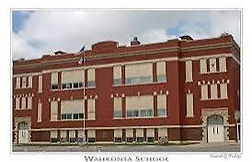
In 1891, an eight-room brick building was erected upon the side of the old fort. The school was named for a friendly young Sioux Indian who had been a frequent visitor at the fort.
At midday, February 2, 1912, the building burned. The day was bitterly cold and a high north wind blew the flames across the street. The heat was so great that families living near the school had to leave their homes. The heat cracked the glass and melted frost on windows in nearby homes. There were only a few pupils in the building with the teachers when the fire started. All had plenty of time to escape from the building.
The fire was on Thursday. On the following Monday the children began school in various rooms in the business district. Two grades went to the Y. M. C. A., two went to the public library, and others to lodge rooms.
A new school was begun immediately, and within a year’s time the present school building was ready. Because the children and teachers had experienced so much inconvenience, they heartily welcomed the new building.
Shortly after the new structure was erected, the school board purchased the plot of ground just east of the building for a playground. At that time an old log cabin on which modern siding had been placed occupied the site. The school board removed the siding and presented the cabin to the Fort Dodge Chapter of the Daughters of the American Revolution. These women had the cabin removed to Oleson Park where it still stands to give us a clear picture of what an early log cabin was like.
In 1928 this society placed a marker on the lawn at Wahkonsa School to mark the site of the old military post. The marker is a bronze tablet set in a five foot stone, and it gives a brief history of the fort.
The old lot school of 1854 has given way to a modern building with a music room and auditorium for the use of the children and patrons. One room has been fitted for a dark room where students may develop films and study photography if they so desire.
Wahkonsa School was located at 330 1st Avenue North.
Wahkonsa School
1891
The location of Wahkonsa School has a great deal of historical interest connected with it. The plot on which the school is built was the site of the old military post from which Fort Dodge had its beginning.
Tobin College was founded in 1892 and was the fourth school founded by Professor Thomas Tobin, the other three being: Tilford Academy, at Vinton, Iowa; Waterloo College, at Waterloo, Iowa , and Ellsworth College, at Iowa Falls, Iowa.
Professor Tobin, who was a native of Ireland, was born August 15, 1835 , and died May 27, 1900. He came to America when fourteen years of age. He did not have a chance to learn his letters until he was seventeen. But even at that age, he had the courage to set out to secure a college education, earning the necessary means himself. But so hard was the struggle, that for three months at a time, he did not have money enough to buy a postage stamp.
After graduation, Professor Tobin resolved to make it easier for backward boys to obtain an education, and to give them a chance to secure instruction suited to their individual needs. Accordingly, in 1870, he came to Iowa and established Tilford Academy, at Vinton. In 1885 he went to Waterloo and started Waterloo College .
In 1889, he removed to Iowa Falls, where he founded Ellsworth College .
Early in the year 1892, he began corresponding with Mr. Frank Gates, Mr. Frank Farrell, and others, concerning the establishment of a college in Fort Dodge. Satisfactory arrangements having been made, Professor Tobin moved his family here in April of the same year, and work on the college was started. The property for the college site was purchased from Mrs. Sarah Dwelle, the widow of the last landlord of the old St. Charles hotel. This property included the hotel and a quarter of a block of ground on the corner of First avenue North and Seventh street. While the college building was not completely finished, yet school began on the second Monday in September, 1892.
The new college began without a name. A week or so after it opened, Professor Tobin was invited by some friends to spend the day in the woods. While he was gone, the teachers and students took matters into their own hands, called a meeting, and by a unanimous vote, christened the new college, "Tobin," in recognition of the work he had done for the cause of education through the founding of so many colleges.
The formal dedication of the building did not take place until the last of October, 1892. The dedicatory exercises consisted of an afternoon and evening program. At these programs, congratulatory addresses were made by prominent business men of the city; also by Rev. William Randall, pastor of the Baptist church at Iowa Falls, and Rev. F. E. Eldredge, state Sunday school missionary of the Baptist church, both of whom were very close friends of Professor Tobin.
The enrollment of the first term numbered about fifty. At the opening of the winter term, many of the country boys came in, and the enrollment reached the one hundred mark. The boarding department, the first fall, numbered about twenty. In the winter this number increased to forty. This department was carried on in the old St. Charles, the kitchen and dining rooms of the college building not being finished until 1893. The faculty the first year numbered nine. Professor Tobin taught general history, which was his favorite subject, and gave the rest of his time to the supervision of the school. Professor J. F. Monk had charge of the stenography department and taught the languages. Mrs. J. F. Monk and Miss Mable Allison taught the normal branches. Professor B. T. Green taught the sciences and mathematics and had charge of the commercial department. The music department was under the direction of Professor W. V. Jones and his daughter, Miss Gertrude Jones. Miss Amelia Goldsworthy had charge of the art department.
The first class graduated in June, 1893, and was composed of thirteen members from the commercial and stenographic departments. Those from the commercial department were: J. Oscar Ahlberg, Otto L. Boehm, Walter M. Boehm, Edwin Brickson, Nora Lenihan, Benjamin F. McNeil, Charles R. Peterson, Jennie M. Slate. The stenography class included: Jurgen N. Anderson, Ella W. Beach, Annie G. Fahey, Lizzie E. Harvison and Bessie B. Norton. The first normal class graduated in 1894, and consisted of Jessie V. Cox and Ida M. Prink.
In 1893, Professor Tobin made a contract with Messrs. Green and Monk, by which they were to take charge of the school, buying it from him. But the hard times in 1893-94 so cut down the attendance, that they were unable to make their payments, and Professor Tobin again assumed active control in the fall of 1894. Professor Monk remained on the college faculty, but Professor Green followed his natural inclination and studied medicine.
During the school year 1894-95, the two literary societies, the Philomathean and the Amphycton, were established. The societies have remained in existence ever since. The Snitkay Debate Prize has had much to do in stimulating the interest in debate. This prize is offered by Dr. C. J. Snitkay, an alumnus of the class of '97, and his wife, Mrs. Emma Monk Snitkay, an alumnus of the class of '95. The society winning the contest in debate is given a prize of $10.00. This prize money has always been used by the societies for the benefit of the school. It was in declamatory work, the teaching of young men and women to think and talk upon their feet, that Professor Tobin was especially interested. To this work he gave freely both of his time, and of his zeal.
Many of the older students of the college remember how night after night, he sat in the rear of the chapel, criticizing and commending, but always urging onward his students. And the present success of many of the alumni is due in a large measure to the training of Professor Tobin. His interest was such that he never missed a program of the literary societies, nor any program in which his students took part. His enthusiasm and interest was so genuine and from the heart that it engendered a longing for success in his pupils.
The first declamatory contest of the college was held in the year 1893, and was won by Miss June McNeil, now Mrs. Kusterer, of Moorland.
In the year 1896, the first of the present series of gold medal contests was held. These contests, held annually, provide for three prizes: A gold medal to the winner; a silver medal to the one winning second place, and a souvenir spoon of the college to the one winning third place. The medals have been the gifts of various persons, who have thus shown their interest in the work of the college. The spoon has always been the gift of the college management. The contest is usually held the last Friday evening in March. A system of preliminary contests held each term leads to the selection for the closing contest in the third term. There are three contestants chosen each term, thus making nine for the finals.
The honors in the contests since their beginning, together with the donors of the medal are as follows:
Year Winner Donor
1896 R. G. Tobin Professor T. Tobin
1897 George E. Q. Johnson Mr. Isaac Garmoe
1898 Mrs. Nora Haviland-Moore Hon. John F. Duncombe
1899 M. J. Fitzpatrick Mr. J. F. Carter
1900 Otto V. Bowman Mr. J. B. Butler
1901 Miss Edith Bird Hon. O. M. Oleson
1902 E. E. Cavanaugh Captain S. J. Bennett
1903 Miss Ethel Jondreau Mr. M. F. Healy
1904 James A. Martin Mr. J. G. Early
1905 Francis Murphy Messrs. Monk & Findlay
1906 Miss Eva Southwick Mrs. Julie Haskell-Oleson
1907 Miss Ellen Schmoker Messrs. Monk & Findlay
1908 Leon W. Powers Mr. H. M. Pratt
1909 William Ryberg Mr. H. D. Beresford
1910 Miss Christine Brown Mr. Charles Iles
1911 Miss Myrtle Tullar Mrs. Margaret Tobin-Pratt
1912 D. L. Rhodes* Mr. John S. Heffner
Perhaps no school of its size has as strong an alumni association as Tobin College . This association was organized in 1895 and now numbers over three hundred. A unique feature of the Tobin College Alumni Association is the alumni fund. This fund was started in 1899 by Professor Tobin, its purpose being "for the aid of worthy students in their efforts to gain an education."
In 1899, Professor Tobin sold the college to Messrs. Monk and Findlay, who have carried on the work along the lines originally laid down. The college has continued to prosper and grow until now the annual enrollment numbers about four hundred.
With the lives of such men as Professor Tobin, Professor Monk and Professor Findlay dedicated to its service, Tobin College could not help but be the source of blessing it is to the community and to the young people who have attended it.
* D. L. Rhodes and Miss Mildred Sperry tied for first place, and on drawing lots the honors went to Mr. Rhodes.
Sources:
*Iowa Biographies Project: History of Fort Dodge and Webster County, Iowa… by H. M. Pratt.1913
*Chicago: The Pioneer Publishing Company, 1913.
Tobin College
1892
The new college began without a name. A week or so after it opened, Professor Tobin was invited by some friends to spend the day in the woods. While he was gone, the teachers and students took matters into their own hands, called a meeting, and by a unanimous vote, christened the new college, "Tobin," in recognition of the work he had done for the cause of education through the founding of so many colleges.
